
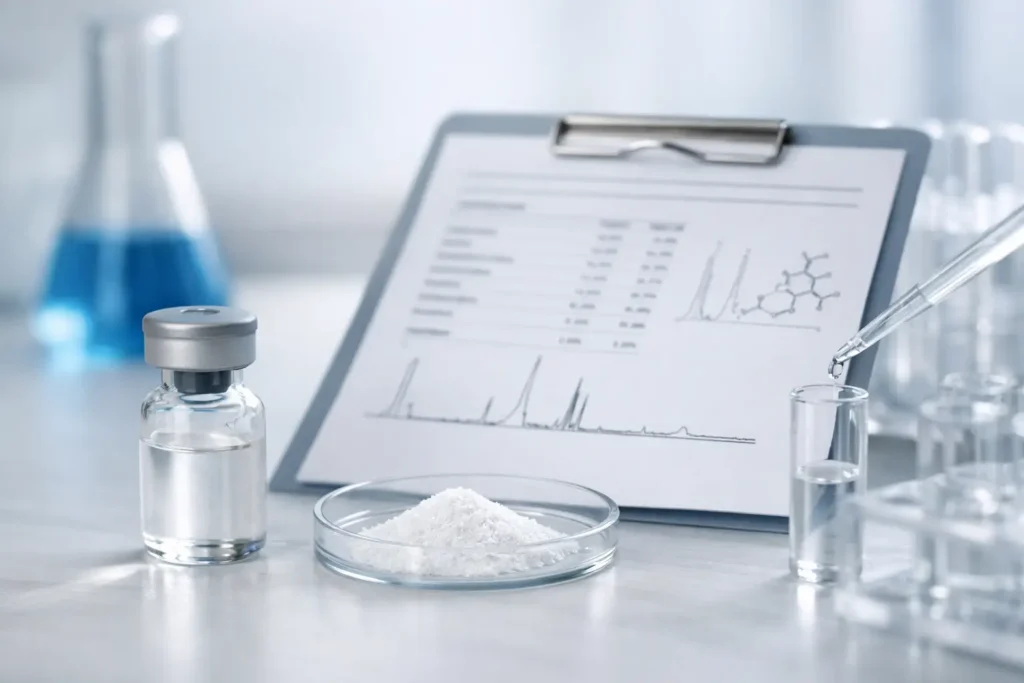
A GHRP-6 acetate purity certificate is not a decorative attachment to a peptide listing. It is the document that allows a research buyer to connect a labelled vial to a defined batch, an analytical method and a reported result. Where identity and consistency affect experimental reproducibility, a generic purity claim is not enough.
For research-use-only material, the useful question is not simply whether a certificate says “98%+”. It is whether the document provides enough batch-specific evidence to assess what was tested, how it was tested, and whether the supplied material can be traced back to that result.
What a GHRP-6 acetate purity certificate should establish
A credible certificate should identify the compound as GHRP-6 acetate, state a unique batch or lot number, and show a test date that can be reconciled with the vial label and dispatch record. These details are basic, but they prevent a common documentation failure: presenting one analytical result as evidence for an unrelated production batch.
The report should also distinguish identity from purity. Purity is normally reported as an area percentage from high-performance liquid chromatography (HPLC), while identity is commonly supported by mass spectrometry. One result does not substitute for the other. A high HPLC area percentage does not, on its own, demonstrate that the principal peak is the intended peptide; a molecular-mass result does not quantify chromatographic impurities.
The acetate designation also matters. GHRP-6 may be supplied in different salt forms, and the documented material should match the stated product form. The certificate should not leave the buyer to infer whether the tested sample corresponds to acetate material or a different presentation.
Purity is a measured result, not a universal claim
HPLC is widely used to separate the principal peptide from detectable related substances and other chromatographically resolved components. A certificate that reports 98%+ purity may be suitable for many non-clinical research applications, but the number must be read in its analytical context.
At minimum, a buyer should be able to see the reported purity result, the method or technique used, and the batch reference. Stronger documentation also includes the chromatogram, retention time, integration data, test conditions or a clear method reference. Those supporting details make it easier for qualified professionals to assess whether the result is specific to the sample and whether the analytical record is internally coherent.
Purity percentages are not directly interchangeable across all laboratories and methods. Gradient selection, column chemistry, detection wavelength, integration settings and sample preparation can influence a chromatographic result. This does not make HPLC unsuitable. It means a serious buyer treats the number as a batch-specific analytical measurement rather than an abstract product attribute.
A certificate should therefore be read with proportion. If a project requires close comparison between batches, confirm that the same analytical approach and reporting standard have been maintained. If the work is exploratory and the critical requirement is verified identity with high reported purity, a clear, current certificate may be sufficient. The appropriate level of scrutiny depends on the research protocol, not on a marketing threshold alone.
Identity verification needs mass-spectrometry evidence
Mass spectrometry provides the separate check that the observed molecular mass is consistent with GHRP-6 acetate. On a well-prepared certificate, this may appear as an observed mass alongside a theoretical or expected mass, with an indicated tolerance. It is a direct line of evidence that the analytical sample contains material consistent with the labelled peptide.
This is especially relevant for synthetic peptides, where closely related sequences, truncations, deletion products and synthesis by-products may not be adequately characterised by a product name alone. HPLC can reveal separation; mass spectrometry helps establish the identity of the principal component.
The word “consistent” is deliberate. Standard quality-control documentation verifies an analytical sample against stated specifications. It does not convert a research material into a medicinal, veterinary, diagnostic or therapeutic product. GHRP-6 acetate should be handled by qualified professionals only and used strictly for legitimate non-clinical research.
Batch traceability is the practical test
The most valuable part of a certificate is often the least dramatic: the batch number. It should match the physical vial, the product record and, where applicable, the order documentation. Without that match, even an impressive chromatogram has limited procurement value.
Full batch traceability allows a laboratory to retain the certificate with its study records, identify the material used in a particular run, and compare documentation if a repeat order is placed later. It also creates a clear route for a supplier to investigate a query without relying on assumptions about when or from where the vial was obtained.
Check the following details together rather than in isolation:
- compound name and stated acetate form;
- unique batch or lot number;
- vial quantity or batch presentation where recorded;
- date of analysis and certificate issue date;
- reported HPLC purity and method reference;
- mass-spectrometry identity result;
- laboratory, reviewer or authorised quality sign-off.
A missing field is not automatically evidence of poor material. Some laboratories issue concise reports, while others provide fuller analytical packs. However, missing batch identification or an absent identity result should prompt a direct documentation query before the material is assigned to research work.
How to identify weak or non-specific documentation
A purity certificate becomes less useful when it is generic, undated or disconnected from the supplied product. A document headed only with a compound name and a broad “pass” statement cannot establish which material was tested. The same applies to certificates reproduced across multiple batches without a distinct lot reference.
Be cautious with purity statements that do not state whether they refer to HPLC area percentage, peptide content, assay by another method, or a supplier specification. These measurements answer different questions. An HPLC purity result is not necessarily a correction for water content, residual solvents, counterion contribution or net peptide content.
This distinction is not pedantry. A research team may need different information depending on its method. For instance, chromatographic purity may be central to a comparative analytical study, while accurate preparation of experimental solutions may call for additional consideration of the supplied salt form and material characterisation. The certificate should support sound scientific judgement, not encourage unsupported assumptions.
Documentation should match handling controls
Analytical verification is strongest when it sits within a controlled supply process. A certificate describes the tested batch at the point of analysis; it cannot by itself prove that every subsequent storage and transport condition was appropriate. That is why dispatch standards, secure packaging and traceable delivery remain relevant to peptide procurement.
For temperature-sensitive research materials, controlled cold-chain dispatch and prompt receipt procedures help protect the value of the analytical record. On arrival, laboratories should inspect the label, retain the batch documentation, record receipt conditions under their own procedures and store the material according to the supplier’s stated handling guidance. Any discrepancy between the vial and certificate should be quarantined and resolved before use.
Helix Bio applies a proof-first approach: batch-specific COAs, independent third-party testing, HPLC and mass-spectrometry verification, and traceable dispatch are intended to give research buyers a documented basis for purchase. The same standard should be expected from any research-grade supplier.
Request the right evidence before reordering
The most efficient procurement process is established before a study begins. Review the certificate for the initial batch, save it within the project record and decide which fields are non-negotiable for future orders. That may be a minimum reported purity, a current mass result, a particular analytical format, or simply consistent lot-level documentation.
If a new batch is introduced, do not assume equivalence solely because the product name and nominal quantity are unchanged. Compare the batch number, reported purity and identity data with the previous record. Where a protocol is sensitive to material variation, document that comparison as part of the laboratory’s normal change-control process.
A well-issued GHRP-6 acetate purity certificate gives researchers something more useful than reassurance: a verifiable starting point for defensible material selection. Retain it, match it to the vial, and let the documented batch – rather than an unqualified headline claim – guide the next research decision.