
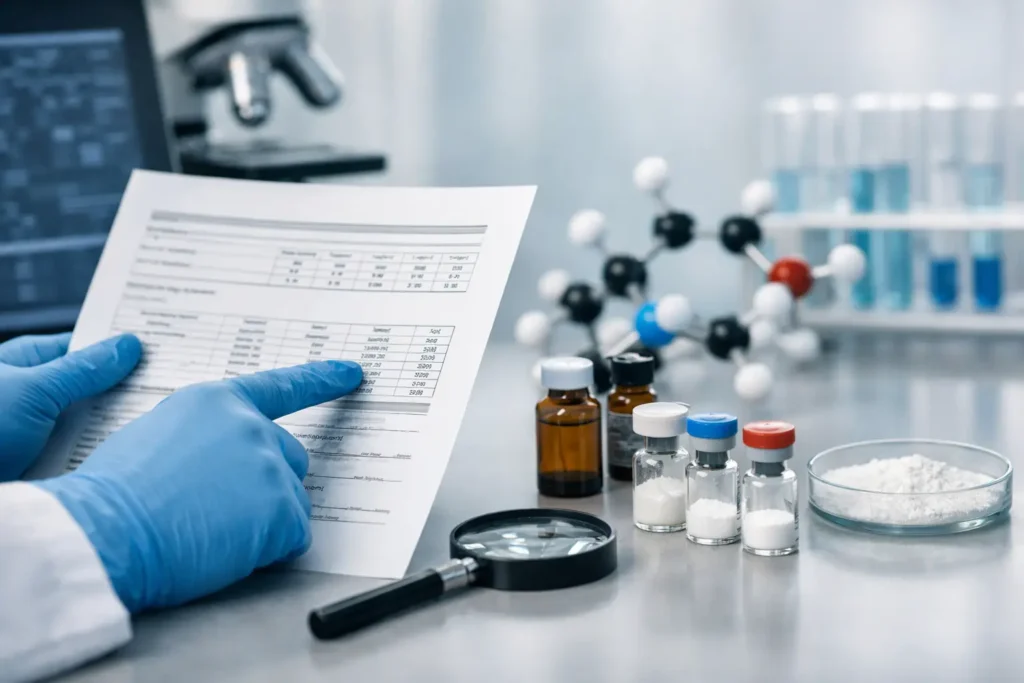
A peptide COA is only useful when it can be tied, without ambiguity, to the vial in hand. For researchers asking how to check peptide COA documentation, the central task is not simply finding a purity figure. It is confirming identity, method, batch linkage and analytical scope before material enters a research workflow.
A credible certificate of analysis should allow a qualified professional to answer four practical questions: what was tested, which batch was tested, how it was tested, and what the result actually supports. A generic document, a supplier-wide purity claim, or an unlabelled chromatogram does not provide the same level of assurance as batch-specific analytical evidence.
How to check peptide COA documentation
Start by matching the document to the product label and purchase record. The compound name must be exact, including the stated form where relevant. For example, an acetate salt, a free base, and a blend are not interchangeable descriptions. The declared peptide sequence or molecular formula should also align with the ordered material.
Then confirm the lot or batch number. This is the control point that turns a COA from marketing collateral into traceable quality documentation. The batch number on the COA should match the batch number shown on the vial, outer packaging or accompanying dispatch record. If the supplier uses a separate internal reference, it should be clearly linked to the saleable batch.
The remaining review should cover the analytical methods, reported findings and document controls. The following checks are most useful when performed together:
- Verify the product name, stated form, quantity and batch or lot number against the physical item and order documentation.
- Review HPLC data for the reported purity, chromatogram quality and method information.
- Review mass spectrometry data for molecular identity and consistency with the expected molecular mass.
- Confirm the test date, issuing laboratory or analyst details, document version and any stated limitations.
A COA that passes one of these checks but fails another deserves follow-up before use. A 99% purity result, for instance, has limited value if there is no reliable way to establish that the result belongs to the batch received.
Confirm molecular identity before focusing on purity
Identity and purity answer different questions. Mass spectrometry is commonly used to support peptide identity by measuring ions consistent with the expected molecular mass. Depending on the method and peptide, a spectrum may show multiple charge states rather than one simple peak. That is normal, provided the reported interpretation is consistent with the material being tested.
Review whether the COA states an expected mass and an observed mass, or otherwise provides a clear pass result against an identity specification. A result described only as “MS passed” is less informative than a result that identifies the measured value and method. For larger or more complex peptides, the analytical presentation may require specialist interpretation, so the absence of a familiar single-ion format is not automatically a concern.
The compound designation matters here. Peptide naming can look similar while referring to materially different research substances. A document for CJC-1295 without DAC should not be accepted as evidence for a DAC-containing variant, and a blend COA should identify the blend components rather than rely on a COA for one constituent. The same discipline applies to salt forms and modified sequences.
Mass spectrometry is strong evidence of molecular identity, but it does not establish chromatographic purity on its own. It should sit alongside separation data, not replace it.
Read the HPLC purity result in context
High-performance liquid chromatography separates components in a sample and reports their relative signal response under defined conditions. In peptide quality control, HPLC is widely used to assess purity and identify detectable related peaks. A stated purity of 98% or higher is a useful operating marker, but the number must be read with the method behind it.
First, establish what the percentage means. Many peptide COAs report HPLC area percentage. This is a chromatographic measurement, not necessarily a full mass-balance assay of every possible component. UV response can vary between compounds, and non-UV-active contaminants may not be represented in the same way. That does not make HPLC unsuitable. It means the result should be described accurately and considered with the rest of the analytical package.
A useful HPLC record identifies the principal peak and its retention time, shows the reported purity, and provides enough method detail to make the result interpretable. Look for items such as the column type, mobile phases, detection wavelength and run conditions where available. The exact format will vary between laboratories, but a chromatogram with no sample identification, no batch reference and no stated result is weak evidence.
Inspect the chromatogram for an appropriately dominant main peak and disclosed secondary peaks. Small peaks are not automatically disqualifying in research-grade peptide material. Their significance depends on their relative abundance, likely origin, the intended non-clinical research application and the specification applied to that product. What should not be accepted is unexplained inconsistency between the chromatogram and the reported purity figure.
A particularly clean-looking chromatogram still has limits. HPLC conditions are selected for a purpose, and a method may not resolve every impurity equally well. This is why independent analytical testing, identity confirmation and full batch traceability should be treated as a combined quality system rather than as separate tick-boxes.
Check who issued the COA and what was tested
The issuing party should be identifiable. A well-controlled COA names the testing laboratory, manufacturer or authorised quality function and includes a report number, analysis date or document issue date. Independent third-party testing provides additional assurance because the analytical result is generated outside the sales function, though independence alone does not compensate for incomplete batch information or poorly defined methods.
Ask whether the certificate applies to the finished batch supplied, a retained representative sample, or a raw material used upstream. Only the first of these directly supports the quality claim for the vial received. Suppliers should be able to distinguish between an internal specification sheet, a representative example and a batch-specific certificate.
The test date also needs context. A historical analysis is not necessarily invalid, particularly for a correctly stored and documented batch, but the material should remain within the supplier’s defined retest or expiry period where one is provided. Storage history and dispatch conditions matter as well. Temperature-sensitive research materials can be analytically sound at release yet compromised by unsuitable handling later in the supply chain.
Look for traceability beyond the certificate
A COA is one component of a traceability record. The strongest purchasing controls connect the certificate to an identifiable batch, controlled storage, documented release and dispatch records. For materials that require cold-chain handling, the supplier’s packaging and transport process should be proportionate to the stated storage conditions.
On receipt, record the batch number, arrival date, packaging condition and storage transfer in the laboratory’s own inventory system. If the outer label, vial label and COA do not reconcile, quarantine the material pending clarification. Do not attempt to resolve a documentation discrepancy by assuming two similarly named products are equivalent.
This approach also supports reproducibility. If an experiment needs to be repeated months later, an accurate batch record makes it possible to identify whether a changed observation may relate to a new production lot, a different peptide form or an altered handling history. It also gives procurement teams a clear basis for requesting the correct replacement documentation.
Know what a COA cannot prove
A COA reports results for the tests performed on the sample analysed. It does not by itself establish suitability for every assay, long-term stability after reconstitution, sterility, endotoxin status, residual solvent profile or biological activity unless those parameters are explicitly tested and reported. Researchers should not infer unlisted attributes from a high HPLC purity percentage.
The appropriate evidence package depends on the work. A comparative analytical study may require batch-specific identity and purity data with retained raw outputs. Another non-clinical application may require additional screening, qualification or incoming verification under the laboratory’s own procedures. More testing has a cost and lead-time trade-off, but it is often justified where an unverified variable could invalidate a larger research programme.
Research-grade peptides are for qualified professionals and non-clinical research use only. A COA is not a therapeutic claim, dosing document or evidence of suitability for human or veterinary use. Keep that boundary clear in purchasing, handling and records.
When documentation is complete, the decision becomes straightforward: accept material only when the molecule, batch and analytical evidence all agree. Suppliers such as Helix Bio that provide COA-verified, batch-specific records make this review more efficient, but the receiving laboratory should still preserve its own chain of traceability. The most useful COA is the one that allows a future researcher to reconstruct exactly what entered the experiment, and why it was accepted.