
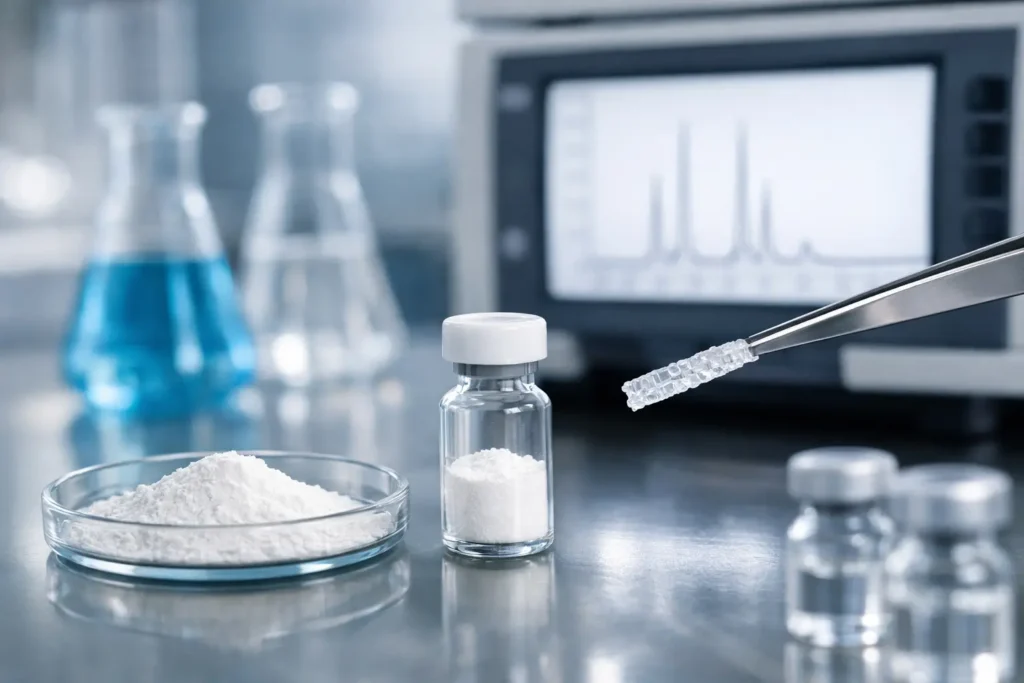
A reported purity figure is only useful when it can be tied to a defined analytical method, a specific batch and an accessible certificate of analysis. The 98% peptide purity standard is therefore not simply a catalogue claim. For research professionals, it is a practical threshold for assessing whether a peptide material has been sufficiently characterised for the intended non-clinical work.
A 98%+ result can indicate a high-quality research material, but it does not mean that every remaining question has been answered. The identity of the principal peak, the nature of residual signals, the assay method, sample handling and batch traceability all affect whether the figure is meaningful. Quality control begins with the percentage, then moves to the evidence behind it.
What the 98% peptide purity standard measures
Peptide purity is commonly expressed as the proportion of the tested sample attributed to the target peptide under a stated analytical method. In routine peptide quality control, reversed-phase high-performance liquid chromatography, or HPLC, separates components according to their interaction with the chromatographic system. The target compound is represented by a principal peak, while additional peaks may indicate related peptides, synthesis by-products, degradation products, residual processing materials or other detectable components.
When a batch is reported at 98% purity by HPLC, the result generally means that the principal peak accounts for at least 98% of the integrated chromatographic area under the defined test conditions. It is a strong operating benchmark for research-grade supply because it places a limit on detectable non-target material within that method. It is not, however, a universal statement that 2% of the vial has been fully identified, nor does it independently confirm molecular identity.
That distinction matters. Chromatographic purity is method-dependent: a different column chemistry, gradient, detector setting or integration approach may produce a different separation profile. A serious certificate of analysis should therefore state the method used and present sufficient batch-specific information for the purchaser to interpret the result in context.
Why HPLC alone is not enough
HPLC establishes separation and supports a purity assessment. Mass spectrometry addresses a separate question: whether the observed molecular mass is consistent with the expected peptide. Used together, HPLC and mass spectrometry provide more defensible evidence than either technique in isolation.
Mass spectrometry can confirm the expected mass-to-charge pattern of the target molecule and can help identify certain unexpected species. This is particularly relevant for peptides where closely related deletion sequences, oxidation products or modifications may be difficult to distinguish from the target solely through a headline purity percentage. For technical buyers, a COA showing both chromatographic purity and molecular-mass verification offers a clearer basis for material acceptance.
There are limits to this combined approach. A correct mass does not prove every aspect of sequence or structural conformation, and an apparently clean chromatogram does not automatically establish absolute purity. More extensive characterisation may be appropriate where a study design, internal quality system or regulatory framework requires it. The required standard depends on the research objective, the compound, the concentration used and the consequences of an unexpected result.
The remaining percentage is not a trivial detail
At 98% purity, up to 2% of the measured chromatographic signal may be associated with non-target components. In some exploratory laboratory workflows, that level may be proportionate to the work being undertaken. In other settings, particularly where analytical sensitivity is high or results depend on narrow differences between experimental conditions, a purchaser may require a tighter specification or additional impurity characterisation.
The practical question is not whether 98% is universally sufficient. It is whether the material specification is appropriate for a documented experimental purpose. A stated acceptance criterion should be considered alongside identity confirmation, quantity, salt form, storage requirements and the laboratory’s own controls.
Reading a COA beyond the headline result
A batch-specific certificate of analysis transforms a purity claim into a record that can be reviewed, retained and compared against future orders. It should connect the sample tested to the material supplied through a batch or lot identifier. Without that connection, a generic analytical statement has limited value for reproducibility.
For a research purchaser, the most useful COA typically records the compound name, batch number, reported purity, analytical methods, date of testing and result for molecular-mass verification. Where chromatographic data are provided, the chromatogram should show a clearly identified main peak and any material secondary peaks. The document should also identify the testing laboratory or the quality function responsible for release.
A certificate is not improved merely by visual complexity. What matters is whether the information is specific, legible and consistent with the product supplied. Check that the stated peptide variant matches the requested material exactly. Similar compound names can represent different sequences, ester or acetate forms, DAC status, blend ratios or vial strengths. These are procurement and experimental variables, not minor labelling details.
For recurring studies, retain the COA with the batch record and laboratory documentation. If a subsequent order arrives under a different batch number, compare the reported purity and mass result before treating the material as equivalent. Small analytical differences may be acceptable, but they should be recognised rather than assumed away.
Purity, handling and batch integrity are connected
A verified release result describes the sample at the point of testing. It does not remove the need for disciplined handling after dispatch. Peptides can be affected by temperature exposure, moisture, repeated handling and unsuitable storage conditions. A credible supply process therefore links testing with controlled fulfilment, secure packaging and traceable delivery.
Cold-chain dispatch is relevant where product stability and specified handling conditions require temperature-managed transit. Its value is not a marketing label but the reduction of avoidable exposure between release and receipt. On arrival, laboratory staff should inspect the package, confirm the batch identifier against the COA, record receipt where required and transfer the material to the specified storage environment without unnecessary delay.
Reconstitution introduces another control point. The selected diluent, aseptic technique, concentration calculation, aliquoting plan and storage period should follow the laboratory protocol and the material documentation. Reconstitution accessories may support a workflow, but they do not compensate for poor identity control or an unsuitable purity specification.
Setting an acceptance standard for your work
A 98%+ requirement is most useful when it sits within a defined incoming-material process. Before purchasing, establish the compound specification, required analytical evidence, acceptable batch-to-batch variation and the record that must accompany the vial. This avoids the common error of treating purity as the only release criterion.
For comparative research, consistency may be as significant as the highest available percentage. A well-documented, traceable batch with HPLC and mass-spectrometry verification can be more useful than an unsupported higher-purity claim. Conversely, a specialised assay may justify requesting additional data or a stricter specification. The correct decision depends on the study, not on a generic purchasing hierarchy.
Helix Bio applies independent third-party testing and full batch traceability to support this evidence-led approach. Materials are supplied for qualified professionals conducting research only, and are not intended for human, veterinary, diagnostic or therapeutic use.
Questions to ask before release into a study
Before incorporating a peptide batch into experimental work, confirm that the compound identity, variant and vial strength match the procurement record. Review the HPLC purity result and mass-spectrometry result together, verify that the COA batch number matches the label, and assess whether the documented specification fits the planned method. If any point is unclear, quarantine the material until the discrepancy is resolved.
This approach is deliberately conservative. It protects experimental interpretation when a result needs to be repeated, challenged or compared months later. A peptide cannot be judged solely by the number printed beside its purity claim; it should be judged by the quality of the evidence that travels with that number.
The useful closing test is simple: if a colleague had to reproduce the work from your records alone, would they be able to identify the exact batch, review its analytical basis and understand why it met your acceptance criteria? If the answer is yes, the 98% figure has served its proper purpose.