
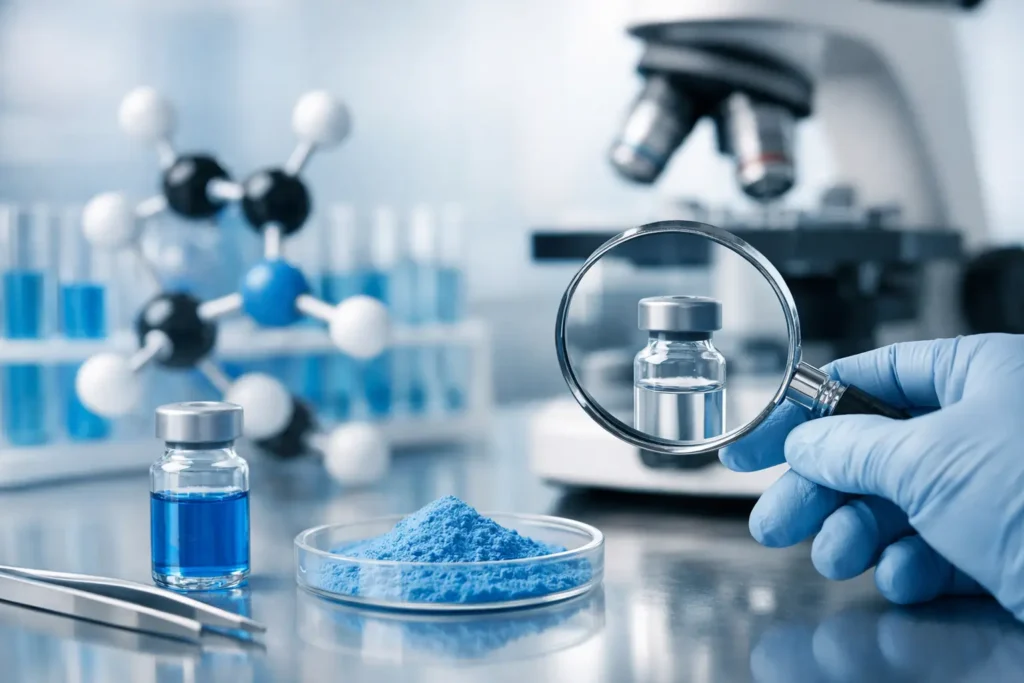
A blue-toned lyophilised vial is not, by itself, evidence of material quality. For a GHK-Cu research peptide, confident purchasing begins with the molecular record: confirmed identity, meaningful purity data, a batch-specific certificate of analysis and a handling chain that supports the condition of the material on arrival.
GHK-Cu is a copper complex of the tripeptide glycyl-L-histidyl-L-lysine, commonly represented as GHK-Cu. Its chemical identity is straightforward to name but more demanding to assess in a procurement setting. Researchers need to distinguish between a product description and documentation that permits scrutiny of the specific batch being introduced into a non-clinical study.
What defines a GHK-Cu research peptide batch?
The first requirement is unambiguous identity. A product label should clearly distinguish GHK-Cu from GHK alone, copper salts or differently formulated peptide materials. The presence of copper is central to the complex being investigated, so a peptide-only result cannot establish that the supplied material corresponds to the stated copper-peptide complex.
Identity confirmation is commonly supported by mass spectrometry, alongside chromatographic analysis. Mass spectrometry provides molecular-weight evidence consistent with the expected analyte, while high-performance liquid chromatography, or HPLC, helps characterise the principal peak and detectable related components. Neither result should be treated as a decorative attachment. Together, they form part of the evidence trail that allows a qualified professional to assess whether the material is appropriate for a defined research programme.
Purity figures also need context. A stated result of 98% or higher may be a useful purchasing threshold, but the method, analytical date and sample-to-batch relationship matter just as much. HPLC area percentage is not a universal statement about every possible impurity, nor does it independently establish copper-complex integrity. It is one analytical measure within a broader quality assessment.
Why the copper complex needs separate attention
GHK-Cu is not assessed in precisely the same way as an uncomplexed peptide. Researchers should consider whether the available documentation identifies the material as the copper complex and whether the supplied analytical information is coherent with that designation. Appearance may offer a preliminary observation, but colour variation alone is not a release criterion and should never replace analytical verification.
This distinction becomes especially relevant when comparing suppliers. Two items with similar names, vial sizes or listed peptide content may not have the same documentary basis, formulation history or handling controls. Price comparison without batch data can obscure those differences.
Reading a GHK-Cu research peptide COA
A certificate of analysis should be linked to the actual batch, not supplied as a generic example. The batch or lot identifier on the COA should match the product label and the supplier’s order record. This simple cross-check supports traceability when samples are divided, retained, compared or re-ordered at a later date.
A useful COA normally identifies the compound, batch number, analytical method and reported result. For peptide materials, HPLC and mass-spectrometry data are particularly relevant. The document should also show a release or test date and name the laboratory or responsible quality function where that information is available.
Independent third-party testing provides an additional layer of separation between manufacture, release and commercial supply. It does not remove the need for a research team to evaluate suitability against its own acceptance criteria. It does, however, provide stronger evidence than an unsupported purity claim copied across multiple batches.
At Helix Bio, the quality position is built around batch-specific COAs, independent analytical verification, HPLC and mass-spectrometry review, and full batch traceability. For buyers, the practical point is clear: retain the documentation with the laboratory record rather than treating it as pre-purchase marketing material.
Questions that reveal a weak documentation trail
If a supplier cannot associate a COA with a live batch, cannot explain the reported method, or provides results without a matching lot number, the material may be difficult to defend in a reproducibility review. The same applies where the product identity is vague or the test results appear to be generic templates.
A high-purity claim should therefore lead to further questions: what was tested, when was it tested, which batch does the result cover, and how is that batch tracked from release through dispatch? Clear answers reduce uncertainty before the material reaches the laboratory.
Handling and delivery are part of material control
Analytical release is only one part of the chain. Research-grade peptide materials can be affected by poor storage, inappropriate temperature exposure, moisture and avoidable handling errors. The relevant conditions depend on the supplier’s product specification and the receiving laboratory’s validated procedures, but the principle remains constant: the dispatched item should arrive in a condition consistent with its documented release.
Controlled cold-chain dispatch is therefore more than a convenience feature. It demonstrates that the supplier has considered the period between controlled storage and laboratory receipt. Tracked delivery provides accountability during that interval, while secure, discreet packaging protects both the shipment and the procurement process.
On receipt, laboratory personnel should reconcile the product name, vial quantity, batch identifier and supporting COA before the item enters local inventory. Any visible damage, missing documentation or discrepancy should be recorded through the laboratory’s established deviation process. This is particularly valuable where a project relies on comparisons between batches or repeated experimental runs.
Researchers should follow the product-specific storage statement and their own institutional procedures. Broad assumptions based on another peptide, another supplier or an earlier batch are not a substitute for the current product record.
Quality data supports better experimental decisions
Verification does not guarantee a biological outcome. A well-documented GHK-Cu research peptide can support confidence in starting-material identity and consistency, but it cannot compensate for unsuitable model selection, uncontrolled variables, weak assay design or inadequate controls.
For comparative or repeat work, batch control should be incorporated into the experimental record. Recording batch numbers, COA references, receipt dates and material handling observations makes later interpretation more defensible. Where a new batch is introduced, researchers may decide that bridging work or additional analytical checks are proportionate to the sensitivity of the study. The right level of scrutiny depends on the method, endpoint and consequence of batch-to-batch variation.
This is where traceability has real scientific value. It enables a team to identify whether an unexpected result coincided with a material change, rather than leaving that question unanswered months later. It also supports clearer communication between procurement, laboratory operations and quality personnel.
Procurement with the research-only boundary intact
GHK-Cu supplied for laboratory investigation is for qualified professionals only and must remain within a research-use-only framework. It is not supplied for human, veterinary, diagnostic or therapeutic use. Clear supplier language on this point is a sign of appropriate compliance discipline, not a limitation to work around.
The strongest purchasing decision balances analytical evidence, documented provenance, dispatch controls and the needs of the planned study. A product page may be concise, but the underlying quality record should allow technical buyers to assess the batch on its merits.
When the material, COA and handling history remain connected from purchase through experimental recordkeeping, GHK-Cu research begins with a far firmer basis for reproducible laboratory work.