
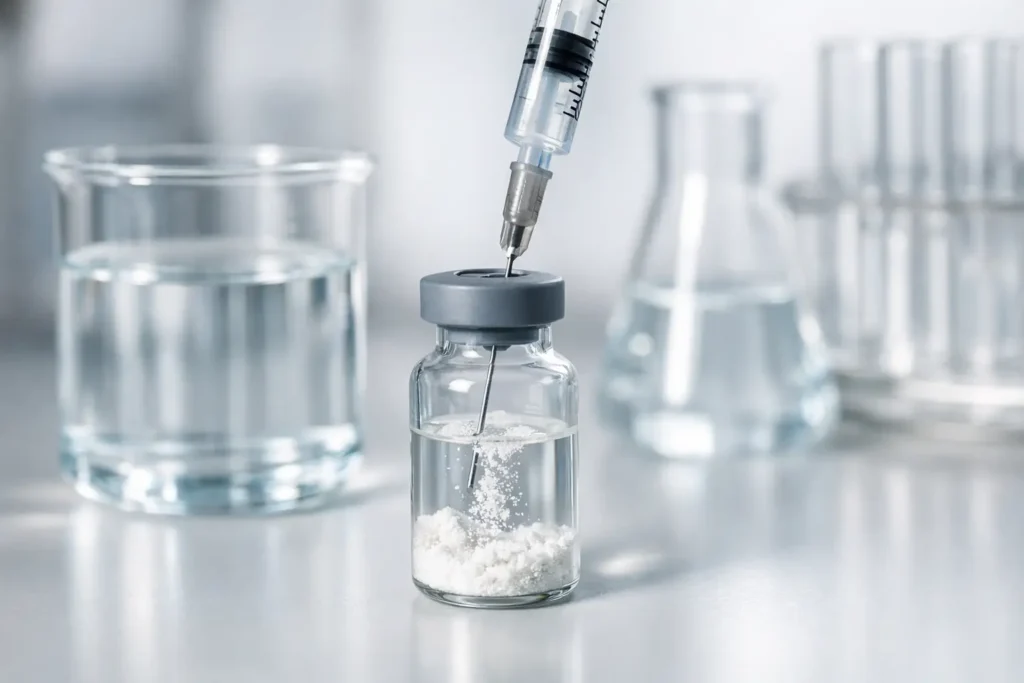
A syringe is a small component in a reconstitution workflow, but it can introduce disproportionate uncertainty when its graduations are unclear, its materials are unsuitable, or its sterility is not documented. Laboratory syringes for reconstitution should therefore be selected as controlled research accessories, not treated as interchangeable consumables. For peptide and related research materials, the objective is repeatable liquid handling that supports traceable, non-clinical laboratory work.
The appropriate choice depends on the intended transfer volume, the viscosity and compatibility of the liquid being handled, the vial closure, and the laboratory’s established procedures. It also depends on what must be recorded. Where a research programme relies on milligram-scale materials, an apparently minor difference in graduation spacing or dead volume can complicate comparisons between runs.
What Laboratory Syringes for Reconstitution Must Deliver
A suitable syringe provides three things at once: legible measurement, reliable handling and a defined quality status. Capacity is the most visible specification, yet it is only one part of the decision. A large-capacity syringe may be useful for bulk transfer, but its graduation intervals may be too broad for small-volume work. Conversely, a very small syringe may provide closer visual control while being impractical for the required transfer volume.
Graduations should be permanent, readable and appropriate to the laboratory’s expected working range. Researchers should distinguish between nominal capacity, graduation interval and the accuracy expected from the individual product specification. These are related, but they are not identical. A clear barrel with high-contrast markings can reduce transcription and observation errors, particularly where work is performed under routine laboratory lighting rather than dedicated metrology conditions.
The barrel, plunger and seal also deserve attention. Materials must be compatible with the liquids and contact conditions defined by the method. A smooth plunger action supports controlled aspiration and dispensing, while a secure seal helps prevent leakage or inconsistent movement. If a method is sensitive to extractables, adsorption or prolonged contact with a particular polymer, the syringe specification should be reviewed against that method rather than assumed suitable by default.
Sterility is equally contextual. For a procedure that requires sterile handling, the syringe should be supplied sterile in intact individual packaging, with the relevant product information available for review. Sterile supply does not replace aseptic technique, environmental controls or qualified handling. It is one controlled input within a wider process.
Start With the Transfer Requirement
The most useful selection process begins with the transfer requirement, not a preferred syringe format. Establish the liquid volume to be handled, the required resolution, the connection type, and whether the syringe will be used for a single transfer or a defined series of controlled operations. This prevents a common mismatch: choosing a syringe that is technically capable of holding a volume but poorly suited to measuring it.
For small liquid volumes, use a capacity that keeps the target volume within a clear, practical part of the scale. Working close to the bottom of a large barrel can make reading less reliable. Working at the absolute limit of a small barrel may introduce other handling concerns. The correct balance is method-specific and should be documented in the laboratory procedure where precision affects the result.
Connection requirements should be confirmed before work begins. Luer-compatible configurations are widely used across laboratory accessories, but the exact fitting, needle attachment and closure interaction must match the approved workflow. Do not force components from different systems together or rely on visual similarity as evidence of compatibility. A secure mechanical connection reduces the risk of leaks, disconnection and avoidable sample loss.
Where a needle is required for vial access or transfer, its selection should be governed by the vial closure, liquid properties, required flow characteristics and the laboratory’s safety controls. Needle gauge and length are not generic quality markers. A configuration appropriate for one closure or transfer volume may be unsuitable for another. Qualified professionals should follow approved site procedures, including sharps controls and disposal requirements.
Dead Volume and Why It Changes Results
Dead volume is the liquid retained within the syringe or attached components after dispensing. It matters most where material is limited, where transfers are small, or where concentration calculations depend on complete delivery. The relevant value is not always the barrel alone. A connected needle or other fitting can add retained volume and change the practical result.
Low-dead-space designs can reduce retained liquid, but they are not automatically the right choice in every workflow. The laboratory should consider whether a low-dead-space configuration is compatible with the required connection, the material under study and the validation or documentation expectations for the procedure. Consistency is often more valuable than changing accessory types between comparable runs.
For research involving high-purity peptide materials, this is particularly relevant. Batch-specific identity and purity documentation establish what was supplied, while controlled handling helps maintain confidence in what was used during the experiment. Both sides of that chain matter. Independent third-party testing and full batch traceability provide a stronger foundation when the consumables and transfer steps are also selected deliberately.
Sterile Supply Is Not a Complete Control System
Individually packaged sterile syringes can support controlled laboratory handling, provided the packaging is intact and the product remains within its stated shelf-life. Before use, inspect the pouch, confirm the product identity and capacity, and check that the barrel and plunger are free from visible damage or contamination. A damaged pack should be removed from the workflow rather than treated as an acceptable exception.
However, a sterile syringe cannot correct poor process control elsewhere. The diluent, vial exterior, workspace, gloves, connections and handling sequence all affect the integrity of the operation. Laboratories should work to their own approved aseptic procedures and risk assessments, using suitable controlled environments where required by the research activity.
Traceability should extend beyond the research material itself. Recording the syringe type, lot where relevant, diluent lot, date, operator and associated material batch creates a more useful record when results need to be reviewed. This level of documentation may be unnecessary for exploratory work with low consequence, but it becomes valuable quickly when experiments are repeated, compared across operators or used to inform later decisions.
Avoid the Most Common Selection Errors
The first error is selecting solely by capacity. Capacity matters, but scale resolution, readability, dead volume and connection compatibility may have greater practical influence on the transfer. The second is assuming all sterile products provide equivalent assurance. Packaging format, stated sterility status, storage conditions and supplier documentation should be assessed against the laboratory’s requirements.
The third is mixing accessory formats within a comparative series without recording the change. A different barrel geometry, plunger design or connection can alter handling behaviour. If a change is necessary due to availability, it should be assessed and noted rather than disappearing into the background of the experiment.
A fourth error is treating reconstitution as a universal instruction rather than a method-specific operation. Material properties, target concentration, solvent choice and stability expectations vary. The research lead should define the method and acceptance criteria. Consumables should support that method, not determine it.
Procurement Should Support Reproducibility
For technically informed buyers, procurement is part of the quality system. Syringes should be sourced with clear product identification, relevant sterility information, consistent supply and packaging appropriate for storage and controlled use. Where research materials are supplied with batch-specific certificates of analysis, it is sensible to apply the same disciplined approach to the accessories that contact those materials.
Helix Bio positions reconstitution accessories alongside research-grade materials for this reason: controlled inputs help preserve the value of verified inputs. High-purity material, independent laboratory results and full batch traceability are strongest when laboratory handling remains deliberate from receipt through to recorded use.
All such products are for qualified professionals conducting legitimate non-clinical research only. They are not supplied for human, veterinary, diagnostic or therapeutic use. Site-specific safety procedures, chemical hygiene requirements and sharps regulations remain the responsibility of the receiving laboratory.
The right syringe is rarely the most complicated option. It is the one whose capacity, graduations, material compatibility, sterility status and connection format can be justified against the method – then used consistently enough that the next result is worth comparing with the last.